Electromagnetic Flow Meter Applications in Water and Process Automation
Water networks and process plants do not improve simply because more instruments are installed. They improve when measurements answer an operational question: how much water entered a zone, whether a pump is working near its intended duty, whether a treatment stage is balanced, or whether a chemical transfer matches the production record.
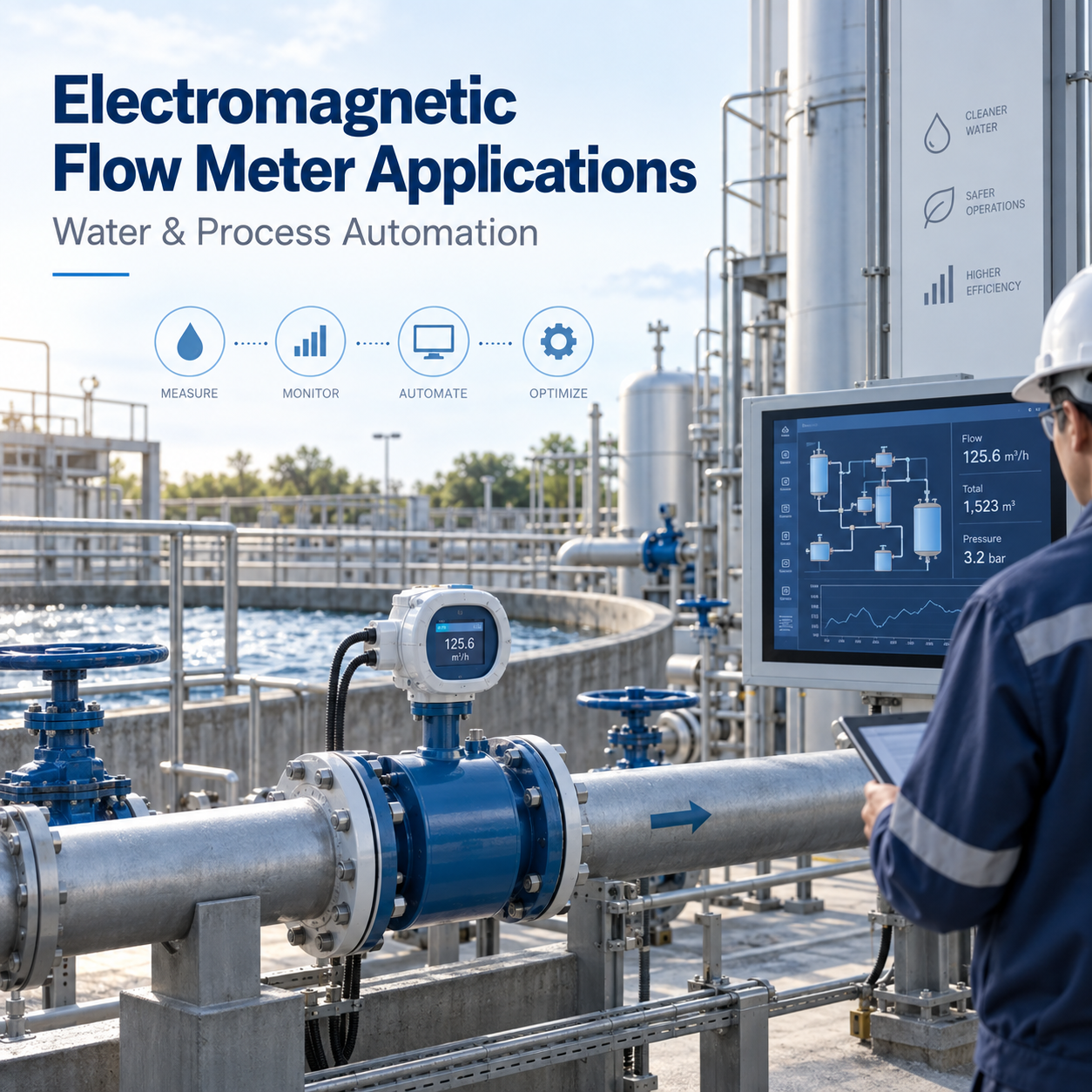
Water networks and process plants do not improve simply because more instruments are installed. They improve when measurements answer an operational question: how much water entered a zone, whether a pump is working near its intended duty, whether a treatment stage is balanced, or whether a chemical transfer matches the production record. An Electromagnetic Flow Meter is often chosen for these duties because it measures conductive liquid through an open bore with no moving element in the flow path.
That broad suitability can hide important differences between applications. Municipal water, abrasive wastewater, corrosive chemicals, and mineral slurry all demand different materials, velocity ranges, diagnostics, and maintenance plans. The industry is moving from isolated flow indication toward connected measurement points that support loss control, energy management, compliance, and predictive maintenance. Good results still depend on basic hydraulic and metrological discipline.
Table of Contents
1. Why Conductive-Liquid Measurement Is Expanding
2. Where Electromagnetic Technology Fits Best
3. Municipal Water: From Bulk Flow to District Metering
4. Wastewater and Slurry Measurement
5. Chemical and New-Energy Process Lines
6. Verification, Calibration, and Data Confidence
7. Procurement Is Moving Toward Application Packages
8. Frequently Asked Questions
9. Build the Measurement Point Around an Operating Decision
Why Conductive-Liquid Measurement Is Expanding
Utilities face pressure to account for treated water from source to customer. Industrial plants face similar pressure to control raw-material use, wastewater discharge, and energy per unit of production. In both settings, an open-bore meter is attractive because there is no rotor to seize and no primary restriction designed to create a pressure differential.
The World Bank has estimated that developing countries lose about 45 million cubic metres of water every day through distribution leakage—enough to serve nearly 200 million people. Metering alone cannot repair a leak, but a well-designed measurement network makes the water balance visible. It allows operators to compare production, zone inflow, minimum night flow, and billed consumption, then direct field teams toward the areas with the largest recoverable loss.
Process industries have a different balance to close. A chemical plant may compare feed flow with tank-level change and finished output. A wastewater facility may use flow to pace chemical dosing or verify discharge volume. A mining operation may watch slurry flow and density together. In each case, measurement creates value when it is tied to a control, accounting, or maintenance decision.
Where Electromagnetic Technology Fits Best
Electromagnetic meters suit conductive liquids in full pipes. They are commonly evaluated for raw water, potable water, wastewater, conductive chemical solutions, pulp stock, and slurries. They are not universal liquid meters: low-conductivity hydrocarbons and many solvents require another method, while gas and steam belong to different technology families.
Selection therefore begins with process physics. The meter must have enough conductivity to produce a stable signal, compatible wetted materials, a useful velocity range, and an installation that keeps the tube full. Once those conditions are met, the technology can cover a wide range of pipe sizes without introducing a moving obstruction.
Technology | Best-fit medium and duty | Main strength | Common limitation to check |
Electromagnetic | Conductive liquids, wastewater, many slurries | Open bore and low added pressure loss | Requires conductive liquid and a full pipe |
Transit-time ultrasonic | Clean liquids and some large pipes | Clamp-on options can avoid pipe cutting | Bubbles, solids, and velocity profile can affect performance |
Turbine | Clean, lubricating liquids with stable flow | Strong pulse output and familiar operation | Moving parts wear; contamination can affect the rotor |
Vortex | Steam, gas, and suitable liquids | No rotating element; useful for several fluid phases | Requires adequate velocity and installation discipline |
Coriolis | High-value mass flow and density measurement | Direct mass flow with high information content | Higher cost and pressure loss may matter at large sizes |
The table explains why many sites use several meter families. An electromagnetic meter may handle wastewater, a vortex meter may serve steam, and a Coriolis meter may protect a valuable dosing stream. Standardising everything on one technology can simplify purchasing but often compromises the application.
Municipal Water: From Bulk Flow to District Metering
Bulk meters at treatment-plant outlets establish how much water enters the network. District metered areas divide a large network into manageable zones so operators can compare inflow with expected demand. Minimum night flow is especially useful because legitimate consumption is lower, making abnormal leakage easier to identify. Electromagnetic meters can support these locations when the water is conductive, the pipe remains full, and the installation provides a stable hydraulic profile.
Data quality matters as much as sensor selection. A meter with the wrong diameter can have poor low-flow resolution, while a damaged cable or bad ground can create noise that looks like consumption. Time stamps must align across zones. Reverse flow needs to be handled deliberately. Maintenance teams also need a method to distinguish real network change from instrument drift.
An Independent Water-Loss Case
A World Bank guidance note describes the water-loss programme of the Saigon Water Supply Corporation in Ho Chi Minh City. The programme established 114 district metered areas and combined measurement with leak detection, repair, and pressure management. About 12,000 leaks were repaired. Within twenty months, reported savings reached 92,000 cubic metres per day—almost three times the original target—and saved water was sufficient to serve about 500,000 additional people. Energy use also fell by about 23,000 kWh per day.
This was not a meter-only success. It shows why flow measurement should be connected to an operating process. Zones, baseline data, leak repair, pressure management, and performance tracking worked together. The case details are available in the World Bank guidance note on non-revenue water and energy efficiency.
Wastewater and Slurry Measurement
Wastewater combines several difficult conditions: suspended solids, fibres, air, changing conductivity, coating, and irregular hydraulic profiles. An open bore removes one obvious blockage point, but it does not eliminate application risk. Liner abrasion, electrode coating, empty-pipe periods, and gas entrainment still require attention.
Velocity should be high enough to limit settlement without creating unnecessary abrasion. A vertical upward section can help keep the tube full and move bubbles through the sensor. In gravity systems, a conventional full-pipe electromagnetic meter may not be suitable if the conduit routinely runs partially filled; a different meter configuration or measurement method may be required.
Slurry applications demand a combined review of particle size, solids concentration, carrier liquid, abrasiveness, and chemistry. A liner selected only for corrosion resistance may wear too quickly. Electrode noise can increase when solids distribution is unstable. Operators should trend signal quality and compare flow against pump condition, density, or tank change instead of relying on a single number in isolation.
Chemical and New-Energy Process Lines
Chemical service shifts attention toward wetted-material compatibility, containment, and control response. Concentration and temperature can change corrosion behaviour, so the generic chemical name is not enough. Cleaning chemicals and upset conditions belong in the material review. Where the liquid is hazardous, enclosure, cable entry, electrical classification, and any required explosion-protection documentation must be defined for the actual installation.
New-energy production introduces conductive liquids in water treatment, precursor preparation, recycling, and utilities. These processes often need integration with automated recipes and batch records. Repeatability may matter more than a single headline accuracy figure. The signal must remain stable across the real flow window, and the totalizer, communication protocol, units, and alarm handling must align with the control system.
Digital communication is useful here because it can carry configuration and diagnostic information alongside the process value. It also creates governance work. Plants need control over parameter changes, device identities, firmware practices, and replacement records. A connected instrument without disciplined asset management can create more uncertainty rather than less.
Verification, Calibration, and Data Confidence
The industry is giving more attention to lifecycle confidence. A factory calibration report confirms performance under controlled conditions; it does not prove that a field pipe is always full or free of disturbed flow. Commissioning must check direction, zero, grounding, scaling, totalization, communication, and comparison with a credible process reference.
ISO 20456 applies to industrial electromagnetic flowmeters for conductive liquid in a full closed conduit. OIML R 49 provides an extensive framework for water-meter performance and testing. The 2024 OIML test-report format records details such as water conductivity, meter orientation, upstream and downstream straight pipe, and flow-straightener installation. Those fields are useful reminders that measurement performance belongs to the complete test and installation condition.
For critical points, a verification plan may include:
· comparison with tank volume, weighment, or another traceable reference;
· review of zero stability during a confirmed no-flow condition;
· inspection of grounding, lining, electrodes, cables, and seals;
· confirmation of configuration, units, damping, output scale, and alarms;
· trend analysis against pump curves, level change, or production balance.
The interval should reflect process severity and business risk. Abrasive slurry and custody-relevant water accounting should not automatically share the same schedule as a stable utility-water loop.
Procurement Is Moving Toward Application Packages
Buyers increasingly ask for more than a sensor and transmitter. They need connection standards, material certificates where applicable, calibration records, tag data, drawings, communication settings, cable requirements, and a commissioning checklist. International projects also need consistent documentation language and revision control.
At AnSanAn, our flow portfolio includes electromagnetic, ultrasonic, vortex, and turbine technologies. That range lets us discuss the application before committing to a principle. We can configure communication, housing, process parameters, and related project details through OEM and ODM support. Our liquid-flow calibration capability then provides a controlled check before shipment.
The stronger purchasing question is not “Which meter is cheapest?” It is “Which measurement point produces the lowest lifecycle uncertainty at an acceptable installed cost?” A slightly higher instrument cost can be justified if it prevents pipe modification, premature liner failure, repeated callouts, or unusable low-flow data. Conversely, an advanced diagnostic package offers little value where the plant has no process to review the alarms.
Frequently Asked Questions
Why are electromagnetic meters widely used in water systems?
Water is normally conductive, and the open measuring tube introduces little additional pressure loss. The technology can cover bulk transfer, treatment, pumping, and district monitoring when the pipe remains full and installation conditions are suitable.
Can one meter specification cover both clean water and wastewater?
Not safely by default. Wastewater may introduce solids, fibres, coating, abrasion, gas, and more variable conductivity. Liner, electrodes, velocity, diagnostics, and maintenance access should be reviewed separately even when pipe size is identical.
Do digital protocols improve measurement accuracy?
Communication protocols improve access to data, configuration, and diagnostics; they do not correct poor sizing, empty pipe, grounding faults, or damaged wetted materials. Measurement quality still begins with the process and installation.
How often should an electromagnetic meter be verified?
There is no universal interval. Consider regulatory requirements, process severity, historical drift, measurement value, accessibility, and whether an independent process balance can detect change. High-risk points deserve a documented verification plan.
Build the Measurement Point Around an Operating Decision
An Electromagnetic Flow Meter becomes valuable when its data leads to action—repairing a leak, controlling a batch, balancing a treatment stage, or proving a discharge volume. Share the process medium, flow envelope, pipe arrangement, control objective, communication standard, and maintenance constraints with AnSanAn. We can help define a measurement package that supports the decision your operators actually need to make.