Smart Differential Pressure Transmitter 0.075% Accuracy Analysis: Technical Principle and Application of Liquid Level/Volume/Pressure Multi-Parameter Measurement
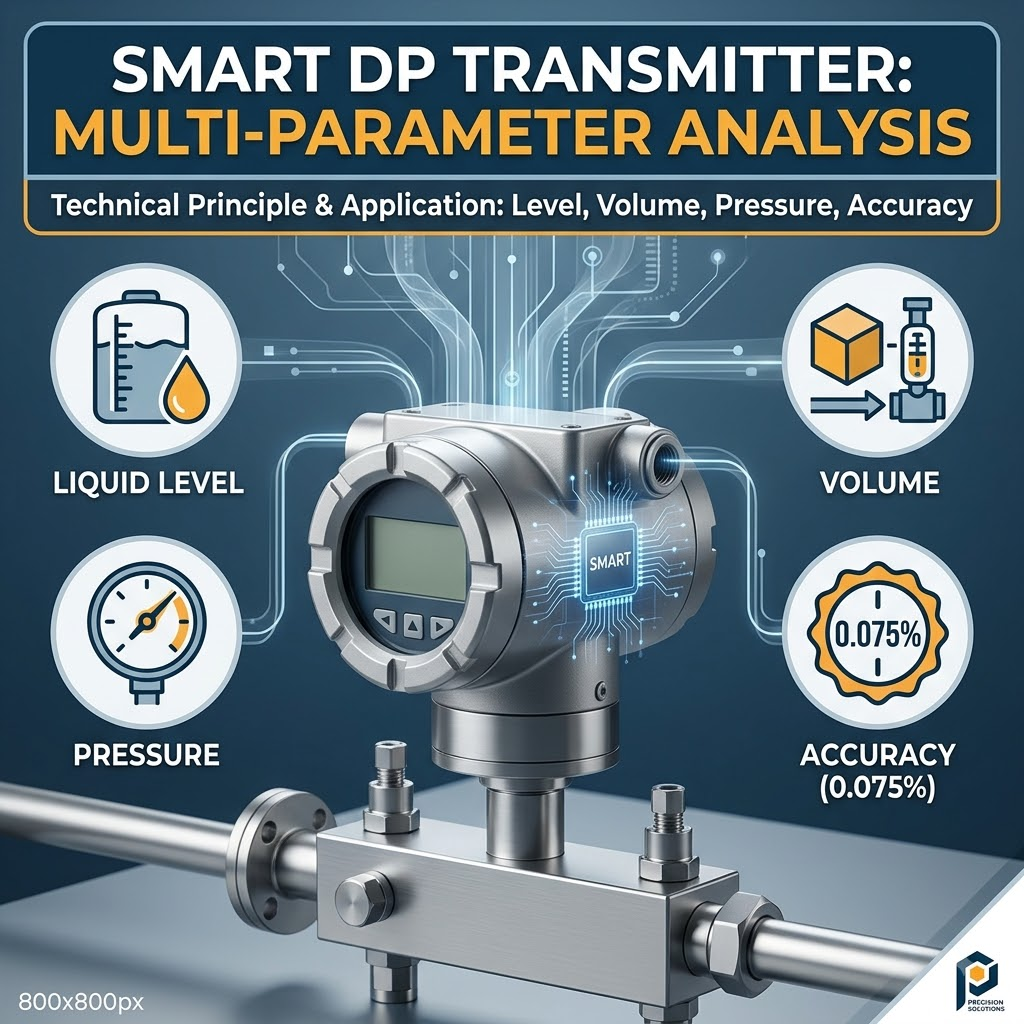
Table of Contents
1. Introduction to High-Precision Smart Differential Pressure Transmitter
2. Technical Advantages of 0.075% FS Ultra-High Measurement Accuracy
3. Multi-Parameter Measurement Principle for Pressure, Liquid Level and Volume
4. Performance Comparison: Smart Transmitter vs Traditional Differential Pressure Transmitter
5. Core Industrial Application Scenarios
6. Professional Industry Q&A
1. Introduction to High-Precision Smart Differential Pressure Transmitter
The smart differential pressure transmitter is a core process measurement device widely adopted in chemical, petrochemical and energy industries. It upgrades traditional mechanical differential pressure detection structures.
Different from ordinary transmitters, this smart pressure transmitter integrates single silicon sensor and digital compensation technology. It supports stable long-term operation under complex working conditions.
Its most prominent feature is the industry-standard 0.075% full-scale accuracy. This precision level meets high-standard industrial calibration and precision monitoring requirements.
Besides basic pressure detection, the device realizes multi-parameter measurement, covering liquid level detection and real-time volume calculation for sealed tanks.
2. Technical Advantages of 0.075% FS Ultra-High Measurement Accuracy
2.1 Definition of 0.075% Accuracy Standard
0.075% FS accuracy means the maximum measurement error does not exceed 0.075% of the full scale range. It includes linear error, repeatability and hysteresis errors comprehensively.
This precision is much higher than the conventional 0.1% industrial standard. It effectively avoids data deviation that may cause process parameter adjustment errors.
2.2 Anti-Drift and Environmental Adaptability
High-precision smart transmitters adopt automatic temperature and static pressure compensation algorithms. It can offset data fluctuations caused by temperature changes and pipeline pressure impact.
Field test data shows that the zero drift per year is less than 0.05%. It greatly extends the equipment calibration cycle and reduces daily maintenance costs.
3. Multi-Parameter Measurement Principle for Pressure, Liquid Level and Volume
3.1 Differential Pressure to Liquid Level Conversion
The basic working logic of liquid level measurement relies on liquid static pressure difference. The transmitter detects the pressure difference between tank bottom and top.
Through built-in density compensation parameters, it converts pressure difference data into accurate liquid level height data in real time.
3.2 Intelligent Volume Calculation Function
Traditional transmitters only output single pressure or level data. The upgraded smart differential pressure transmitter embeds tank capacity curve algorithm.
It can automatically complete liquid level volume measurement. It outputs real-time storage volume of sealed storage tanks, realizing one-device multi-purpose monitoring.
4. Performance Comparison: Smart Transmitter vs Traditional Differential Pressure Transmitter
The following verified industry test data clearly reflects the performance gap between high-precision smart transmitters and traditional products, highlighting application value:
Performance Index | Traditional Differential Pressure Transmitter | 0.075% Accuracy Smart Pressure Transmitter |
Full-Scale Measurement Accuracy | ±0.1%~±0.2% FS | ±0.075% FS |
Supported Measurement Parameters | Only differential pressure | Pressure, liquid level, volume (multi-parameter) |
Annual Zero Drift | ≥0.12% FS | ≤0.05% FS |
Applicable Working Condition | Stable indoor environment only | High temperature, high pressure and outdoor complex environment |
Spare Parts Inventory Cost | High (single function, multiple models required) | Low (one device covers multiple working conditions) |
It is obvious that smart transmitters with 0.075% accuracy have comprehensive advantages in precision, stability and functional diversity. It perfectly solves the single-function limitation of traditional differential pressure transmitters.
5. Core Industrial Application Scenarios
In petrochemical storage tanks, multi-parameter measurement realizes real-time monitoring of oil pressure, liquid level and storage volume. It ensures accurate inventory counting.
In power plant water supply systems, high-precision differential pressure detection avoids water level deviation. It supports stable operation of boiler systems.
In pharmaceutical and food processing industries, the temperature and pressure compensation function adapts to hygienic working conditions. It meets strict industrial measurement standards.
6. Professional Industry Q&A
Q1: What industrial scenarios require 0.075% high-precision differential pressure transmitters?
A1: It is mainly suitable for precision industries such as petrochemical storage, power boiler monitoring and pharmaceutical process control. Scenarios that require strict inventory accuracy and stable process parameters must adopt this precision grade.
Q2: What is the core advantage of multi-parameter measurement function?
A2: It replaces three independent devices for pressure, liquid level and volume detection. It simplifies on-site installation, reduces pipeline transformation costs, and improves data synchronization consistency.
Q3: How long is the calibration cycle of 0.075% accuracy smart pressure transmitter?
A3">Benefiting from low drift design, the professional calibration cycle can be extended to 12–18 months. It is much longer than the 6-month cycle of traditional transmitters, greatly reducing maintenance downtime.